Reading a Letter How to Write Script
So you want to write a pic script (or, every bit some people phone call it, a screenplay – they're 2 words that mean basically the aforementioned thing). We're here to help with this simple step-by-step screenwriting guide.
- ane) Lay the groundwork
- 2) Flesh out the story
- 3) Write the script
- 4) Wrap things upward
Writing a script? Then you lot demand a storyboard. Effort the #1 storyboard software for modern video teams.
Lay the background
1. Know what a script is
If this is your first fourth dimension creating flick magic, y'all might exist wondering what a script actually is. Well, it can be an original story, straight from your encephalon. Or it can be based on a true story, or something that someone else wrote – similar a novel, theatre production, or newspaper commodity.
A movie script details all the parts – sound, visual, behaviour, dialogue – that yous need to tell a visual story, in a movie or on Television set. Information technology'due south commonly a team effort, going through oodles of revisions and rewrites, not to mention beingness nipped 'due north' tucked by producers, directors, and actors. But it'll by and large start with the difficult work and brainpower of one person – in this case, yous.
Because films and Television receiver shows are audiovisual mediums, budding scriptwriters need to include all the audio (heard) and visual (seen) parts of a story. Your job is to translate pictures and sounds into words. Importantly, you lot need to show the audition what's happening, not tell them. If y'all nail that, you'll exist well on your way to taking your characteristic film to Hollywood.
ii. Read some scripts
The kickoff step to stellar screenwriting is to read some neat scripts – as many as you tin tum. It's an specially practiced idea to read some in the genre that your script is going to be in, so you tin get the lay of the land. If you're writing a comedy, try searching for '50 best comedy scripts' and starting from there. Lots of scripts are available for gratuitous online.
3. Read some scriptwriting books
It's besides helpful to read books that become into the craft of writing a script. In that location are tonnes out at that place, simply we've listed a few corkers below to go you started.
- Your Screenplay Sucks! – William M. Akers
- The Coffee Interruption Screenwriter – Pilar Alessandra
- The 21st Century Screenplay – Linda Aronson
- The Nutshell Technique – Jill Chamberlain
- The Art of Dramatic Writing – Lajos Egri
- Screenplay – Syd Field
- The Sequence Approach – Paul Joseph Gulino
- Writing Screenplays That Sell – Michael Hague
- Getting Information technology Write – Lee Jessup
- On Writing – Stephen Male monarch
- Inside Story Dara Marks
- Story – Robert McKee
- My Story Tin can Beat Upward Your Story – Jeffrey Alan Schechter
- Making a Good Script Great – Linda Seger
- Relieve the Cat – Blake Snyder
- The Author'due south Journeying – Christopher Vogler
- Into the Wood – John Yorke
4. Watch some great films
A quick way to make it the scriptwriting zone is to rewatch your favourite films and figure out why you like them so much. Make notes well-nigh why yous dear sure scenes and bits of dialogue. Examine why you're drawn to certain characters. If you're stuck for ideas of films to scout, check out some 'best movies of all time' lists and work through those instead.
Get the Ultimate PDF Storyboard Template Bundle
10 professionally designed storyboard templates as prepare-to-use PDFs.
Mankind out the story
5. Write a logline (a.yard.a. brief summary)
You're likely to be pretty jazzed about writing your script afterward watching all those cinematic classics. Just before y'all dive into writing the script, nosotros've got a little more work to do.
Kickoff up, you need to write a 'logline'. It's got nothing to practise with trees. Instead, it'southward a tiny summary of your story – unremarkably 1 sentence – that describes your protagonist (hero) and their goal, as well as your antagonist (villain) and their conflict. Your logline should set out the basic idea of your story and its general theme. Information technology'southward a chance to tell people what the story's nearly, what way information technology's in, and the feeling it creates for the viewer.
In the olden days, you lot would print your logline on the spine of your script. This was so producers could quickly glance at information technology and decide whether they wanted to read the whole script. A logline does the same affair, just you usually tell people in person or include it when yous give them the treatment.
six. Write a handling (a.k.a. longer summary)
One time your logline's in the bag, it's time to write your treatment. Information technology's a slightly beefier summary that includes your script's title, the logline, a listing of your main characters, and a mini synopsis. A treatment is a useful thing to show to producers – they might read it to decide whether they want to invest fourth dimension in reading your entire script. Well-nigh importantly, your treatment needs to include your proper name and contact details.
Your synopsis should give a practiced movie of your story, including the important 'beats' (events) and plot twists. It should besides innovate your characters and the general vibe of the story. Anyone who reads it (hopefully a hotshot producer) should learn enough that they start to feel a connection with your characters, and desire to run across what happens to them.
This stage of the writing procedure is a chance to look at your entire story and get a feel for how information technology reads when it's written downwardly. You lot'll probably run across some parts that work, and some parts that need a little tweaking earlier you beginning writing the finer details of each scene.
7. Develop your characters
What'south the central question of your story? What's information technology all nigh? Graphic symbol development ways taking your characters on a transformational journey so that they can answer this question. Y'all might find it helpful to complete a grapheme profile worksheet when you're starting to flesh out your characters (you can find these for free online). Whoever your characters are, the nigh important thing is that your audition wants to get to know them, and tin empathise with them. Even the villain!
8. Write your plot
By this bespeak, you lot should have a pretty clear thought of what your story'southward about. The next step is breaking the story downward into all the small pieces and inciting incidents that make upward the plot – which some people telephone call a 'vanquish canvass'. There are lots of different ways to do this. Some people use flashcards. Some use a notebook. Others might use a digital tool, like Trello, Google Docs, Notion, etc.
Information technology doesn't really matter which tool you utilize. The about important matter is to separate the plot into scenes, then majority out each scene with extra details – things similar story beats (events that happen) and data virtually specific characters or plot points.
While information technology'due south tempting to dive correct into writing the script, it'due south a good idea to spend a good portion of time sketching out the plot first. The more detail you lot can add hither, the less time you'll waste later. While you're writing, call up that story is driven past tension – building information technology, then releasing it. This tension means your hero has to change in club to triumph against conflict.
Writing a script? Then you need a storyboard. Try the #i storyboard software for modern video teams.
Write the Script
9. Know the basics
Earlier you start cooking up the first draft of your script, it's good to know how to do the basics. Put just, your script should be a printed document that'southward:
- 90-120 pages long
- Written in 12-point Courier font
- Printed on 8.5" ten 11", white, three-hole-punched newspaper
Font fans might balk at using Courier over their beloved Futura or Comic Sans. However, it'south a non-negotiable. The film manufacture's love of Courier isn't purely stylistic – it's functional, too. One script folio in 12-point Courier is roughly i minute of screen fourth dimension.
That'southward why the folio count for an average screenplay should be betwixt xc and 120 pages, although it's worth noting that this differs a flake by genre. Comedies are usually shorter (90 pages / 1.five hours), while dramas can be a little longer (120 pages / two hours). A brusque flick will be shorter still. Obviously.
10. Write the kickoff page
Using script formatting programmes ways you no longer need to know the industry standard when information technology comes to margins and indents. That said, information technology's skilful to know how to prepare your script in the right mode.
- The top, lesser and right margins of a screenplay are 1"
- The left margin is 1.v" (the actress half-inch of white infinite on the left of a script page lets you demark your script with brads, but still makes the certificate feel balanced in terms of the amount of text on the page)
- The unabridged document should be unmarried-spaced
- The first item on the first page should be the words 'FADE IN:'
- The first folio is never numbered
- The other page numbers become in the upper right-hand corner, 0.5" from the superlative of the page, flush right to the margin
11. Format your script
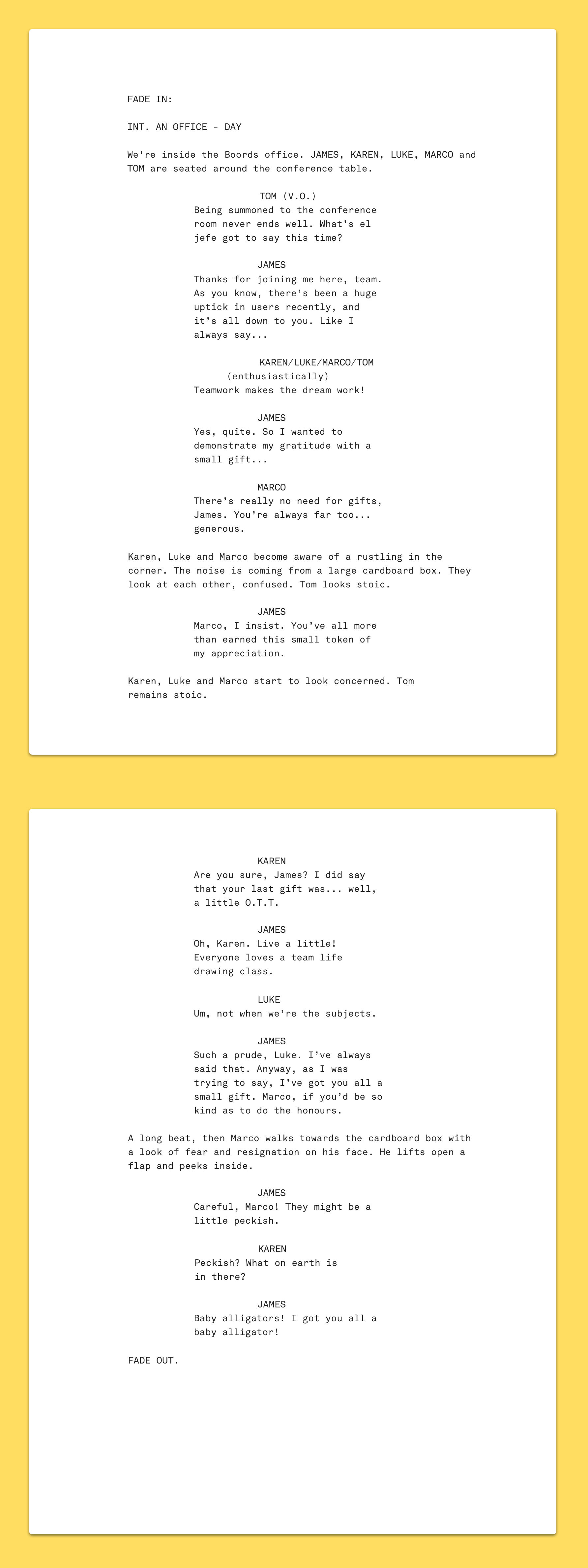 A sample script from an all-hands Boords team meeting
Hither'south a big ol' list of items that you lot'll need in your script, and how to indent them properly. Your script-writing software will handle this for you, but learning'southward fun, right?
Scene heading
 Indent: left: 0.0" / right: 0.0" / width: 6.0"
The scene heading is where you include a 1-line description of the location and time of day of a scene. This is likewise chosen a 'slugline'. Information technology should ever be in caps.
Case: 'EXT. BAKERY - Night' tells yous that the activity happens outside the bakery during the nighttime.
Subheader
 Indent: left: 0.0" / correct: 0.0" / width: 6.0"
When you don't need a new scene heading, but you lot need to make a distinction in the action, you can throw in a subheader. Go piece of cake on them, though – Hollywood buffs frown on a script that's packed with subheaders. One reason you might employ them is to brand a number of quick cuts between 2 locations. Hither, you would write 'INTERCUT' and the scene locations.
Action
 Indent: left: 0.0" / correct: 0.0" / width: 6.0"
This is the narrative description of what'southward happening in the scene, and it'south e'er written in the present tense. You lot can as well phone call this direction, visual exposition, blackstuff, description, or scene management. Think to only include things that your audience can run into or hear.
Character
 Indent: left: two.0" / right: 0.0" / width: four.0"
When yous introduce a character, you should capitalise their proper noun in the action. For case: 'The automobile speeds up and out steps GEORGIA, a muscular woman in her mid-fifties with nerves of steel.'
You should always write each grapheme'south name in caps, and put it about their dialogue. You tin can include minor characters without names, like 'BUTCHER' or 'LAWYER.'
Dialogue
 Indent: left: 1.0" / right: 1.5" / width: 3.v"
Your dialogue is the lines that each character speaks. Utilise dialogue formatting whenever your audience tin hear a grapheme speaking, including off-screen speech or voiceovers.
Parenthetical
 Indent: left: 1.five" / right: 2.0" / width: ii.five"
A long word with a simple significant, a parenthetical is where you requite a graphic symbol management that relates to their attitude or action – how they do something, or what they exercise. Nevertheless, parentheticals have their roots in quondam school playwriting, and yous should only use them when you admittedly need to.
Why? Considering if you need a parenthetical to explain what's going on, your script might just need a rewrite. Also, it's the director's chore to tell an actor how to give a line – and they might not appreciate your abundance of parentheticals.
Extension
 Placed afterward the character's name, in parentheses
This is a shortened technical notation that yous put afterward a character'southward proper name to show how their voice will be heard onscreen. For example: if your character is speaking as a voiceover, it would announced every bit 'DAVID (Five.O.)'.
Transition
 Indent: left: iv.0" / right: 0.0" / width: 2.0"
Transitions are moving picture editing instructions that unremarkably merely appear in a shooting script. Things like:
- Cutting TO:
- DISSOLVE TO:
- SMASH CUT:
- QUICK CUT:
- FADE TO:
If you're writing a spec script, you lot should steer articulate of using a transition unless there'south no other fashion to depict what'due south happening in the story. For example, y'all might use 'DISSOLVE TO:' to show that a big portion of time has passed.
Shot
 Indent: left: 0.0" / correct: 0.0" / width: 6.0"
A shot tells the reader that the focal point in a scene has changed. Again, it's not something you should apply very often as a spec screenwriter. It'south the director'due south job! Some examples:
- Bending ON --
- EXTREME CLOSE Upwardly --
- PAN TO --
- DAVE'South POV --
12. Spec script vs. shooting script
A 'spec script' is some other way of saying 'speculative screenplay.' It'southward a script that you're writing in hopes of selling it to someone. The film world is a wildly competitive market place, which is why you lot need to stick to the scriptwriting rules that we talk most in this post. Yous don't desire to annoy Spielberg and co.
One time someone buys your script, it's at present a 'shooting script' or a 'production script.' This version of your script is written specifically to produce a moving picture. Considering of that, it'll include lots more technical instructions: editing notes, shots, cuts, and more than. These instructions help the production assistants and manager to work out which scenes to shoot in which gild, making the best use of resources similar the phase, cast, and location.
Don't include any elements from a shooting script in your spec script, like photographic camera angles or editing transitions. Information technology's tempting to do this – naturally, you accept opinions about how the story should wait – just information technology's a strict no-no. If y'all want to have your way with that stuff, then try the independent filmmaker route. If you want to sell your script, stick to the rules.
thirteen. Choose your weapon
While writing a large-screen smash is hard work, it'due south a heck of a lot easier nowadays thank you to a smorgasbord of affordable screenwriting software. These programmes handle the script format (margins, spacing, etc.) so that you can get down to telling a great story. Here are a few programmes to check out:
- Celtx
- Fade In
- Final Draft
- Highland
- Moving picture Magic Screenwriter
- Movie Outline
- Montage
- StudioBinder
- WriterDuet
There are as well a tonne of outlining and development programmes. These make it easier to collect your thoughts and storytelling ideas together before you put pen to newspaper. Take a peek at these:
- Contour
- Dramatica
- Save the True cat!
xiv. Make a programme
When you're approaching a chunky project, it'southward always good to set a deadline and then you've got a articulate goal to accomplish. You probably want to allow 8-12 weeks for writing a pic script – this is the amount of time that the manufacture would usually requite a writer to work on a script. Be sure to put the deadline somewhere you'll see information technology: on your calendar, or your phone, or tattooed on your paw. You lot should also tell a few friends well-nigh your goal so that they pester you and concord you accountable.
For your kickoff draft, concentrate on getting words on the folio. Don't be likewise disquisitional – just write whatever comes into your caput, and follow your outline. If you lot tin crank out 1-2 pages per 24-hour interval, you'll have your beginning draft within two or three months. Piece of cake!
Some people find it helpful to write at the same time each day. Some people write first thing. Some people write late at nighttime. Some people have no routine any. Some people need to turn off their phone and cyberspace to exist able to concentrate. Notice a routine (or lack thereof) that works for yous, and stick to it. You got this.
15. Read it out loud
One surefire way to come across if your dialogue sounds natural is to read it out loud. While yous're writing dialogue, speak information technology through at the aforementioned time. If information technology doesn't flow, or it feels a lilliputian stilted, you lot'll demand to make some tweaks. Highlight the phrases that need work then come back to them later when you're editing.
16. Take a break
When your draft's finished, you might recall information technology's the greatest affair ever written – or you might call back it's pure dross. The reality is probably somewhere in the middle. When you're deep inside a creative projection, information technology'due south hard to see the forest for the trees.
That's why it's important to take a decent intermission between writing and editing. Look at something else for a few weeks. Read a book. Watch Television. Then, when you come back to edit your script, yous'll be able to see it with fresh eyes.
17. Make notes
Subsequently y'all've taken a good break, read your whole script and accept notes on the $.25 that don't make sense or sound a piffling weird. Are at that place sections where the story'due south disruptive? Are the characters doing things that don't push the story along? Discover those $.25 and make liberal use of a red pen. Like we mentioned earlier, this is a skillful time to read the script out loud – adding accents and performing lines in a way that'southward true to your vision for the story.
As you lot work towards a final version of your script, you might desire to share it with some people to get their feedback. Friends and family members are a good kickoff port of call, or other writers if yous know whatever. Ask them to give feedback on whatsoever parts y'all're concerned well-nigh, and encounter if there's anything that didn't brand sense to them.
Storyboarding and animatics for modern video teams. Get organized, produce your best piece of work.
Wrap things up
19. Write terminal draft
Subsequently you've made notes and gathered feedback, it's time to climb back into the weeds and work towards your concluding draft. Continue making edits until you're happy. If you need to make changes to the story or characters, do those outset as they might aid fix larger problems in the script.
Create each new draft in a new document so y'all can transfer parts you similar from old scripts into the new one. Drill into the details, only don't get so bogged down in modest things that you can't finish a draft. And, before y'all start sharing information technology with the world, exist sure to do a serious spelling and grammer check using a tool like Grammarly.
20. Presentation and bounden
There are rules for everything when writing a script. Even how y'all demark the thing. Buckle upwards!
- The commencement page is the title page, which should exist written in – y'all guessed it! – 12-point Courier font
- The title page must include the championship of your script, with 'written by' and your name in the eye of the page
- Put your contact data in the lower left-paw or right-hand corner
- You can besides put Registered, WGA or a copyright notification in the lower left-hand or right-manus corner, simply this is entirely optional
- Recall: no graphics, no pictures, no funny business concern
This is a list of stuff you'll demand to set up your script before sending information technology out and taking over the world:
- Script covers (either linen or standard card stock)
- Three-hole-punched paper
- Screenplay brass fasteners (a.k.a. brads). Acco number 5, size 1 ane/4-inch, for scripts up to 120 pages. Acco number 6, size 2-inch, for larger scripts
- Script binding mallet (optional)
- Screenplay brass washers
- Script mailers
And this is how to demark your script:
- Print your title page and script on vivid white three-hole-punched paper
- Insert the title page and script into the script embrace. The front end and back covers should be blank – they're just there to protect the script
- Insert two brass fasteners in the first and tertiary holes. Go out the center hole empty
- Turn the script over, and slide the brass washers over the arms of the fasteners. Spread the artillery of the fasteners apartment against the script. (Optional: use a script binding mallet for an actress-tasty fit)
- Use script mailers to send your film script out to Hollywood bigwigs
- Achieve fame and fortune. Give thanks Boords in your Oscars acceptance speech
Writing a script? Then you need a storyboard. Endeavour the #1 storyboard software for modern video teams.
Source: https://boords.com/how-to-write-a-script
0 Response to "Reading a Letter How to Write Script"
Post a Comment