Images of Painting of African Americans in the Arts
Henry Ossawa Tanner was known as 1 of the nigh famous African American artists of the 19th century and paid a tentative homage to the African American customs and culture through ane of his well-nigh applauded paintings, The Banjo Lesson (1893). Nosotros volition discuss this painting in more detail in the article below.
Table of Contents
- 1 Artist Abstract: Who Was Henry Ossawa Tanner?
- two The Banjo Lesson (1893) past Henry Ossawa Tanner in Context
- ii.i Contextual Analysis: A Brief Socio-Historical Overview
- 3 Formal Analysis: A Brief Compositional Overview
- 3.1 Subject Thing
- 3.2 Color and Light
- 4 "Monsieur Tanner, L'artiste Américaine"
- 5 Frequently Asked Questions
- 5.one Who Painted The Banjo Lesson Painting?
- 5.2 Where Is The Banjo Lesson Painting Now?
- v.3 What Does The Banjo Lesson Painting Hateful?
Artist Abstract: Who Was Henry Ossawa Tanner?
Henry Ossawa Tanner was born on 21 June 1859, Pittsburgh in Pennsylvania. He was known as 1 of the first African American artists with international acclamation. He was given his heart proper name in accolade of the anti-slavery boondocks Osawatomie. Tanner studied at the Pennsylvania Academy of Fine Arts and was taught past the American realist Thomas Eakins.
In 1891 he started studies at the French Académie Julian, which influenced a large part of Tanner's art.
He was besides part of the American Fine art Gild and traveled to the Centre East where his artwork would also be influenced past Orientalism. Tanner painted in the genres of Religion, Genre, and Landscape paintings. Tanner died on May 25, 1937, while he was sleeping.
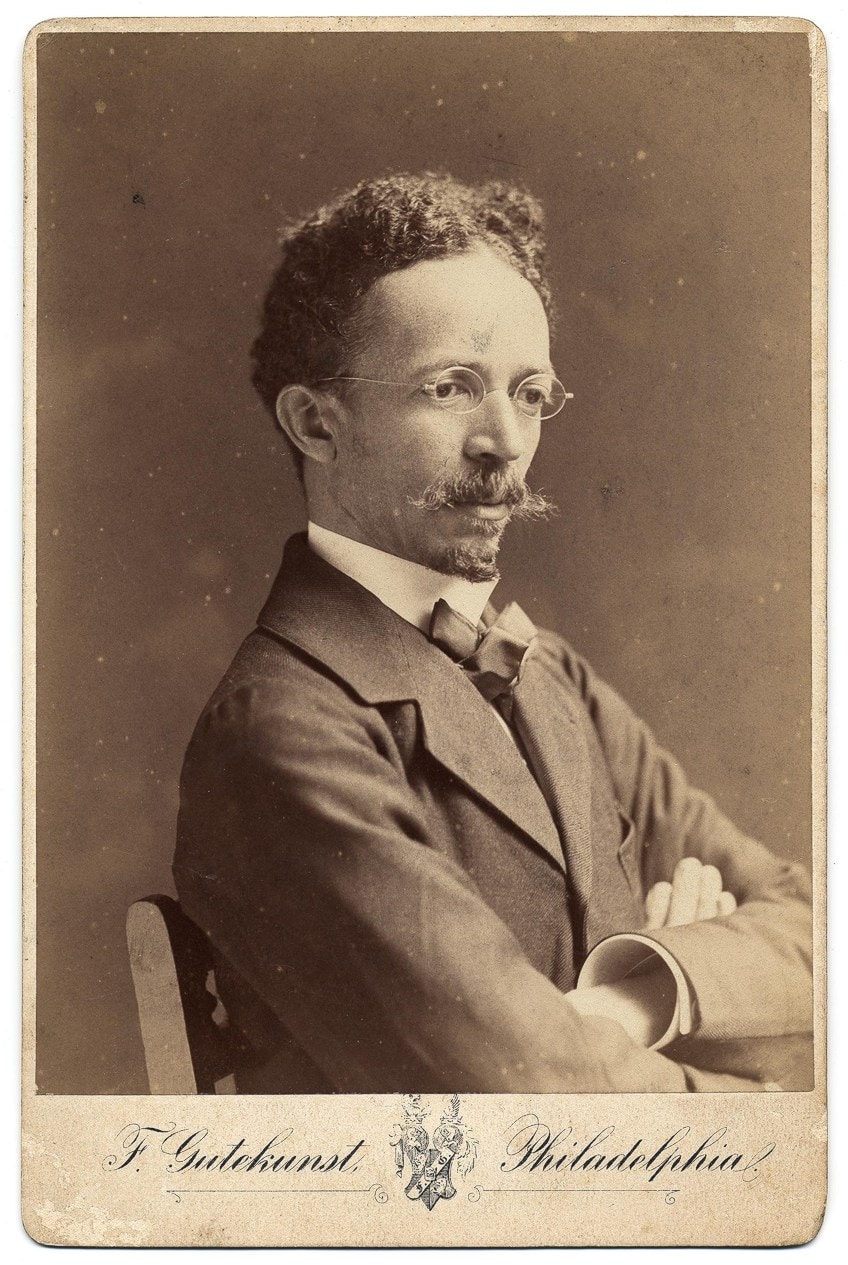 A portrait of Henry Ossawa Tanner, 1907;Smithsonian Institution from United States, No restrictions, via Wikimedia Commons
The Banjo Lesson (1893) by Henry Ossawa Tanner in Context
Henry Ossawa Tanner was an American Realist painter who painted in several genres and themes that ranged from landscapes, people, and religion. His training was bridged betwixt America and Paris, which ultimately shaped and created his creative oeuvre.
This commodity will wait at one of the many examples from the Henry Ossawa Tanner artwork drove, namely "The Banjo Lesson" painting.
We will provide a cursory contextual assay discussing why Tanner made this painting followed by a formal analysis discussing the stylistic aspects like color, lite, and perspective, including taking a closer look at the bailiwick matter.
| Artist | Henry Ossawa Tanner |
| Date Painted | 1893 |
| Medium | Oil on sail |
| Genre | Genre painting |
| Period / Move | American Realism, Symbolism |
| Dimensions | 124.5 x xc.ii centimeters |
| Series / Versions | Non applicable |
| Where Is Information technology Housed? | Hampton Academy Museum, Virginia, United States |
| What Information technology Is Worth | Not bachelor |
Contextual Analysis: A Cursory Socio-Historical Overview
Henry Ossawa Tanner came from a family with roots non only in religion simply besides in slavery. His mother, Sarah Elizabeth Miller, fled from her life equally a slave and found freedom through the secret Underground Railroad routes. Tanner's father was a bishop at the African Methodist Episcopal Church and undoubtedly laid a foundation for religion in Tanner'south upbringing.
As someone who adult a love for fine art from a young age, Tanner's life was about producing art; he studied from some of the virtually notable teachers.
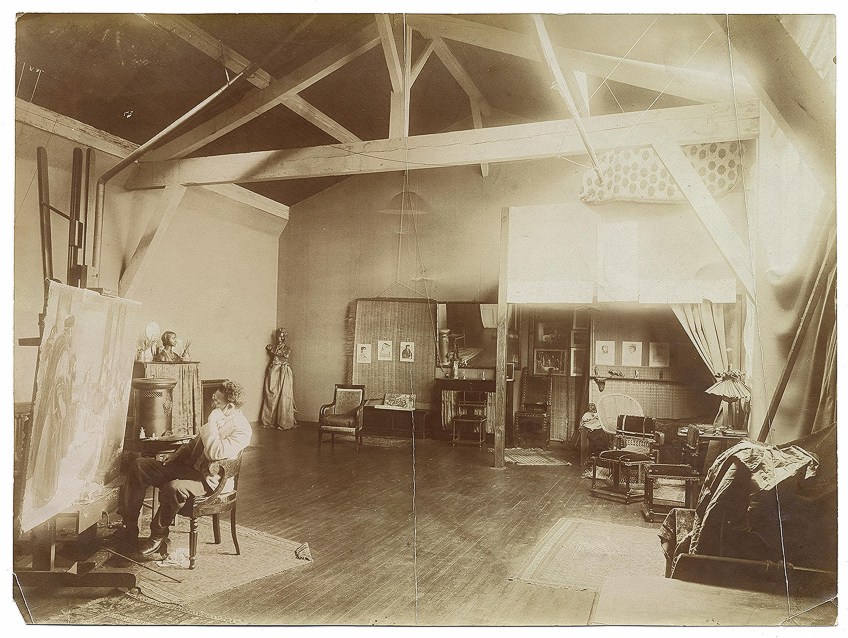 Henry Ossawa Tanner in his studio in Paris, c. 1920;Smithsonian Institution, Public domain, via Wikimedia Commons
First at the Pennsylvania University of Fine Arts under Thomas Eakins, who was a well-known American Realist, painting portraits of various people and their activities. Eakins apparently influenced Tanner to a large extent.
When Tanner moved to Europe in 1891, he found his way to Paris and started studies at the Académie Julian. It is no surprise that during Tanner'south fourth dimension in Europe, he was exposed to the budding and emerging art styles of the time, namely Impressionism and Symbolism. He would finish up living abroad and occasionally traveled to the The states for different purposes.
The Story Backside The Banjo Lesson
Tanner traveled dorsum to the United states of america due to Typhoid Fever. While he recuperated in N Carolina, in the Appalachian Mountains, he was exposed to the realities of how African Americans lived; there was severe poverty. While he stayed there, he drew the people that lived there.
It was during this trip when Tanner took a serial of photographs and created several illustrations for the periodical "Harper'south Immature People" in December 1893.
In it, a short story was published past Ruth McEnery Stuart titled Uncle Tim's Compromise on Christmas (1893). One of the images portrayed the scene of a young boy and older man playing the Banjo; the young boy was also learning how to play it. This was the inspiration behind The Banjo Lesson painting.
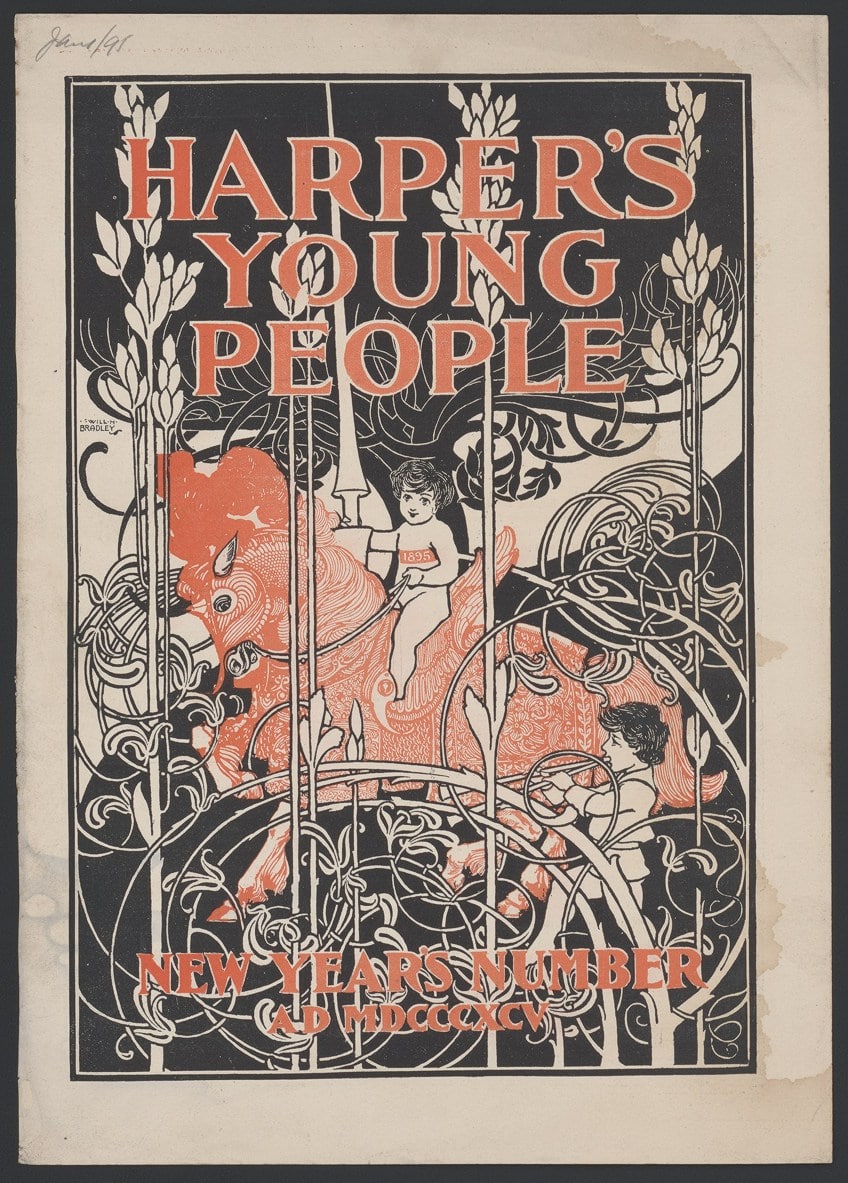 Harper's Young People New Year's number, 1895;Bradley, Will, 1868-1962, artist, Public domain, via Wikimedia Eatables
The brusk story was about an older homo (Uncle Tim) and his Banjo was his only "personal possession", which he gave to the younger boy for Christmas on the status that it be shared betwixt them. This was Uncle Tim's compromise.
The story illustrates Tanner's painting, describing that "It was the i thing the little boy counted on as a precious future holding, and ofttimes, at all hours of the 24-hour interval or evening, old Tim could exist seen sitting earlier the cabin, his arms around the boy…And sometimes, holding the banjo steady, he would invite little Tim to try his tiny hands at picking the strings".
Tanner created an image that moved away from the stereotypical portrayals of African Americans that were so prevalent in nineteenth-century paintings, which showed them playing the Banjo every bit entertainment and entertainers, or as information technology has been described "minstrel" Banjo players.
What Tanner portrayed in The Banjo Histrion painting was giving African Americans back their pride and dignity. He depicted the subjects, the boy and human being, as human beings and non these "other" figures merely relegated to make others happy through amusement, or more harshly, slavery.
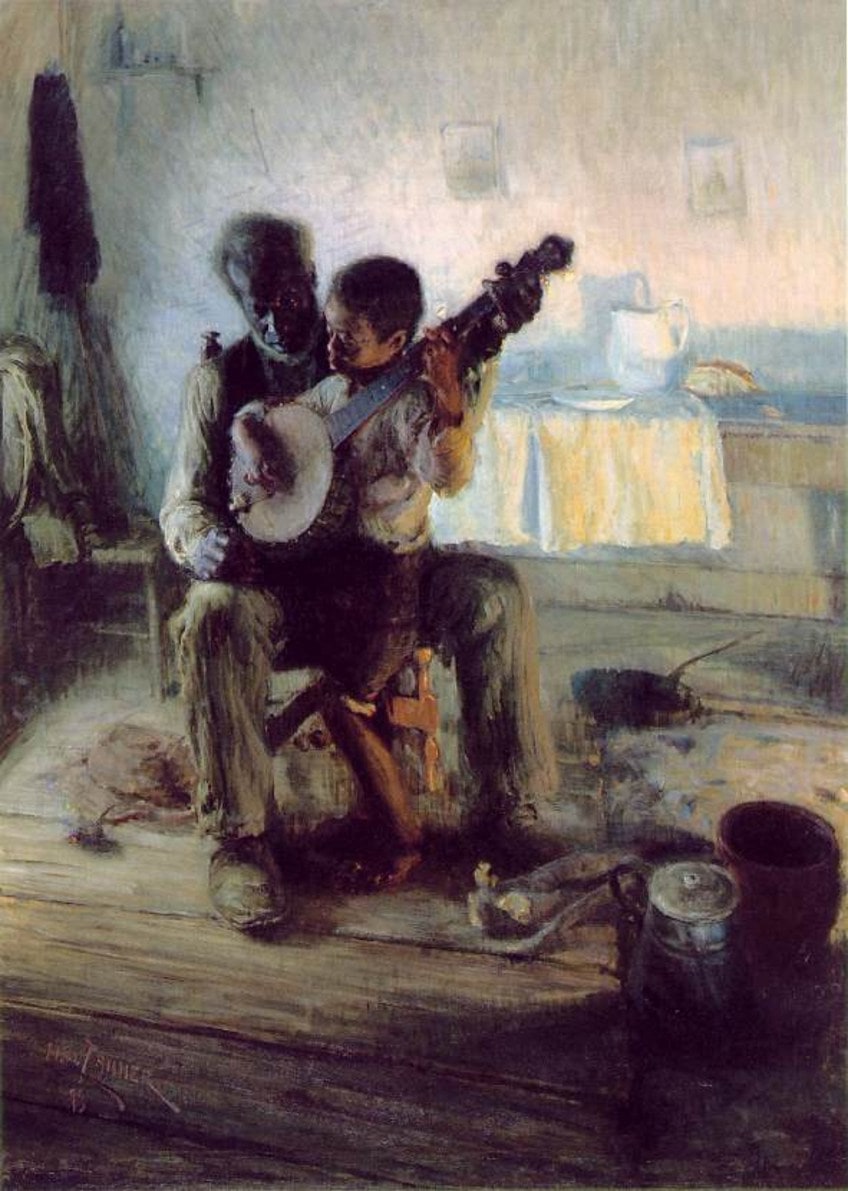 The Banjo Lesson (1893) by Henry Ossawa Tanner;Henry Ossawa Tanner, Public domain, via Wikimedia Commons
Formal Analysis: A Brief Compositional Overview
Beneath nosotros discuss The Banjo Lesson painting in more detail and how this iconic Henry Ossawa Tanner artwork conveys a more than nuanced portrayal of African Americans through the artistic styles of American Realism and traditional paintings.
Subject Matter
In The Banjo Lesson painting, Henry Ossawa Tanner depicts an interior space with ii central figures who are African American. At that place is an older man with gray hair who sits on a wooden chair. His right mitt rests on his right foreleg (our left) and his left mitt (our correct) is placed over the strings on the top part of a Banjo holding information technology up. In concentration, his head partially tilts to his right (our left).
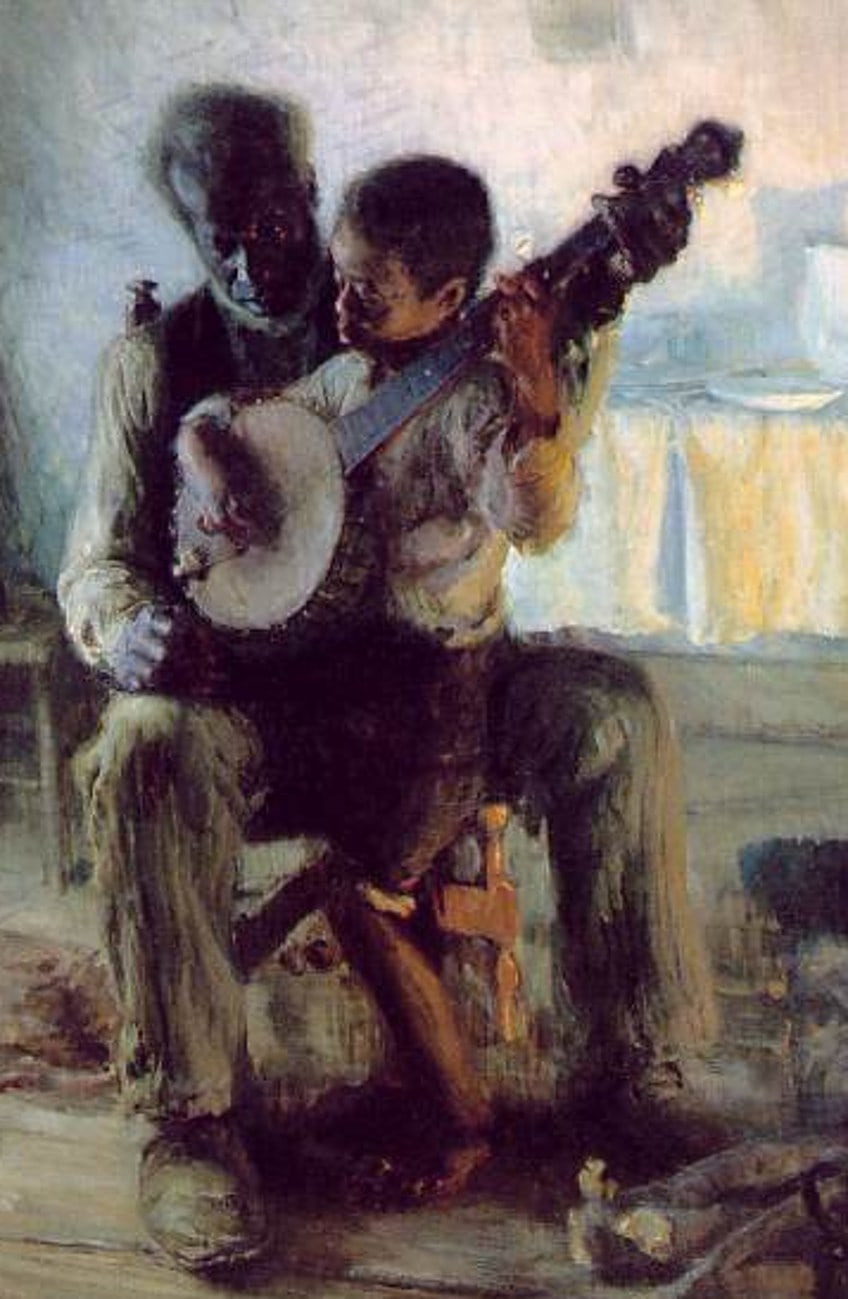 A close-upward of The Banjo Lesson (1893) by Henry Ossawa Tanner;Henry Ossawa Tanner, Public domain, via Wikimedia Commons
In that location is a young boy standing betwixt the older human being's legs, which announced considerably larger than the boy, giving him enough infinite to lean on the inside of the man's left leg (our correct). The male child is busy playing the same Banjo; he is beingness taught past the older human being.
Both appear in deep concentration as they play, learn, and teach this instrument together in quiet reflective demeanors.
We will notice surrounding the cardinal figures is what appears to be a living area with just a few items that suggest kitchen and cooking wares. Towards the wall to the left of the composition is another chair with what appears to be jackets hung over it, above it is some other jacket hanging on the wall.
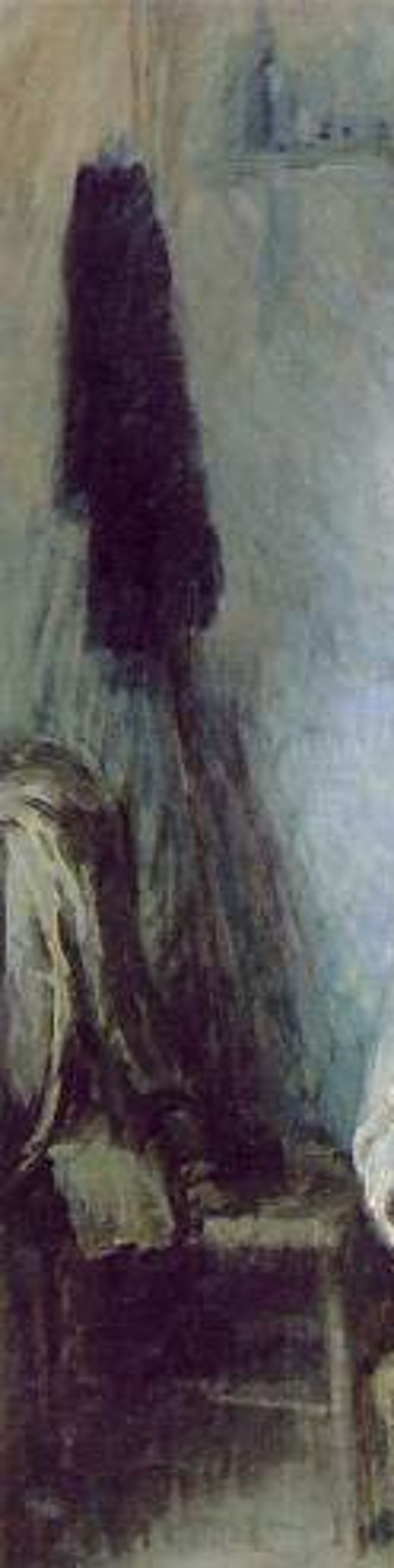 A detail of The Banjo Lesson (1893) by Henry Ossawa Tanner;Henry Ossawa Tanner, Public domain, via Wikimedia Eatables
On the wall backside the cardinal figures, at that place is a small shelf in the top left corner with a few unnoticeable items on it, the only detail that is more recognizable appears to be the white candle on the right. At that place are likewise 2 frames hanging on the wall.
Leaning against the aforementioned back wall is a long tabular array with a white tablecloth draped over, on information technology is a large white pitcher, white plates, and other items suggesting this is a dining area.
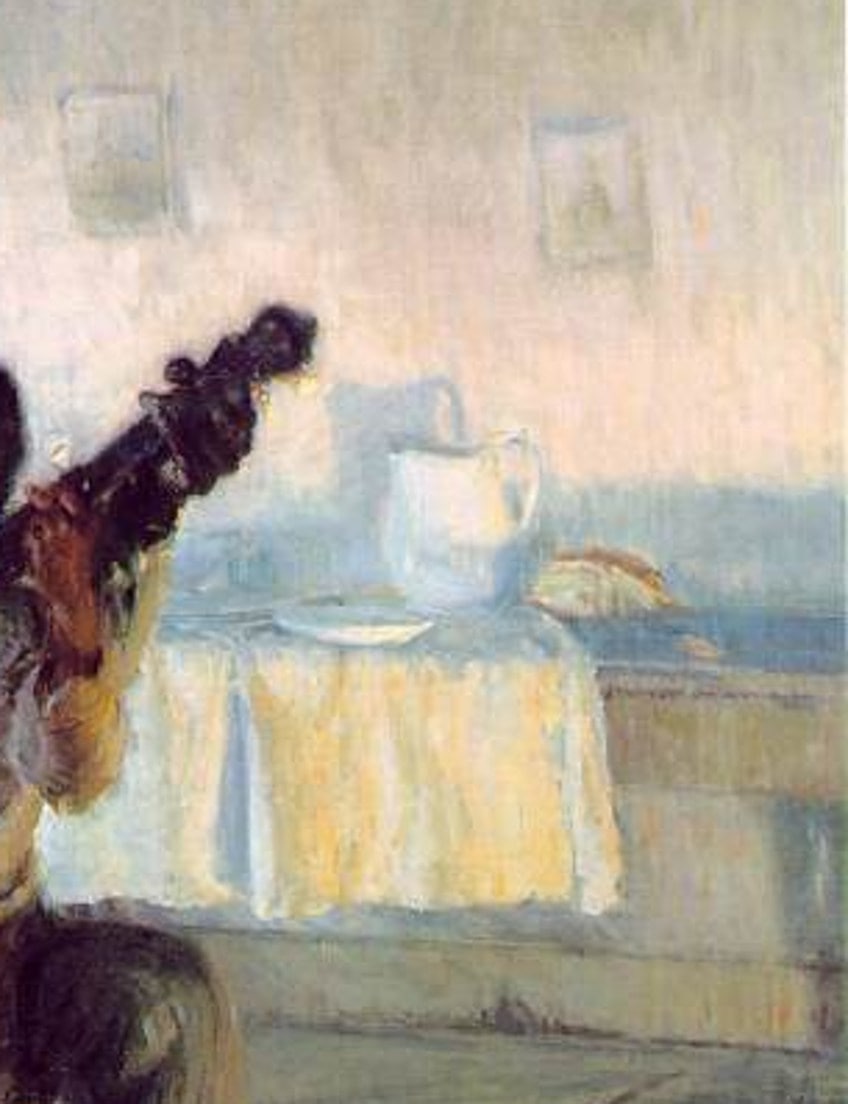 A particular of The Banjo Lesson (1893) by Henry Ossawa Tanner;Henry Ossawa Tanner, Public domain, via Wikimedia Eatables
In the bottom right foreground of the composition, we meet a large pan, a pot, and what seems to be a large stainless-steel jug with a chapeau, peradventure for boiling h2o in. The floor is fabricated of wooden floorboards and there are a few other unrecognizable objects strewn on the floor.
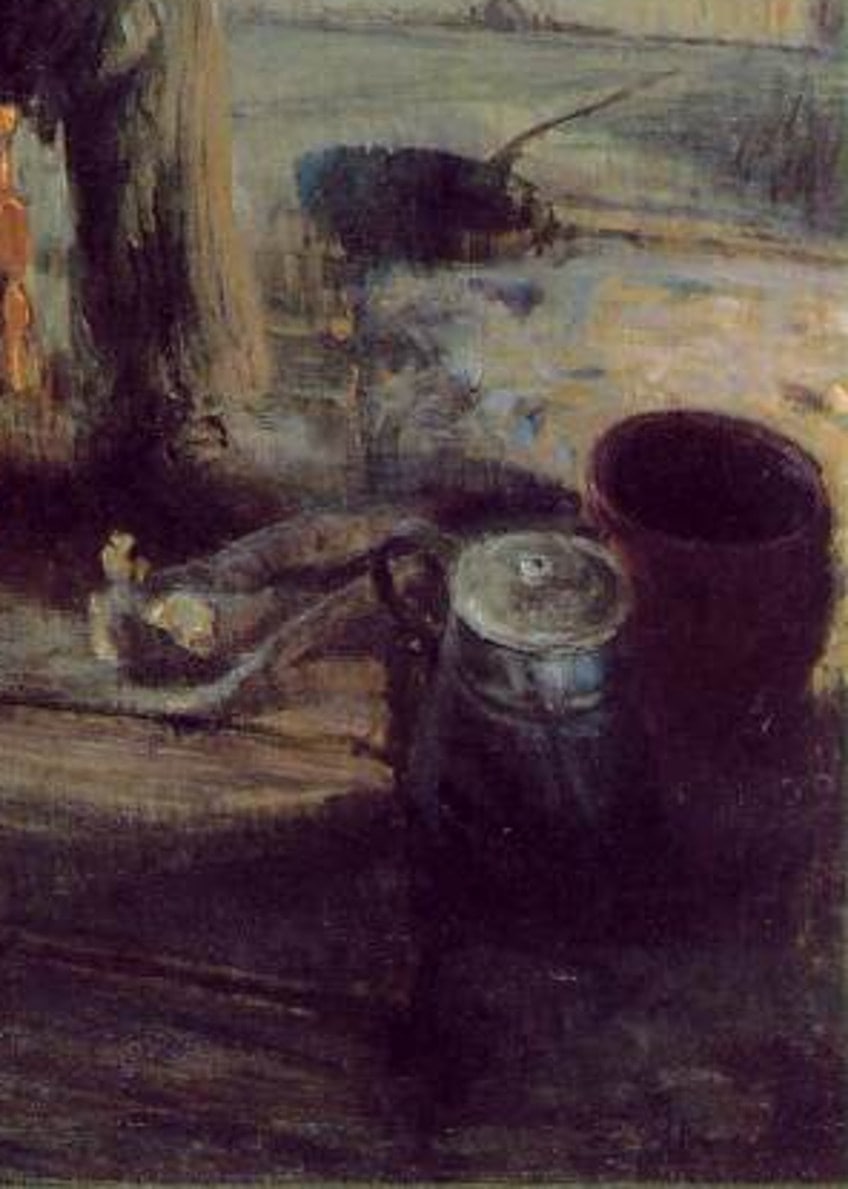 A particular of The Banjo Lesson (1893) by Henry Ossawa Tanner;Henry Ossawa Tanner, Public domain, via Wikimedia Commons
Colour and Light
We will find in The Banjo Lesson painting Henry Ossawa Tanner depicts ii unknown light sources on both sides of the key figures. On the left side of the limerick, this light source is perchance coming from a window, it is in a cooler blue tone. Nosotros see this particularly lighting upward office of the jacket hanging on the chair. On the right side, in that location is a larger expanse of warmer tones of color that suggest there is a fireplace to the right, where we cannot view it.
This burn calorie-free lights up virtually of the left of the composition, giving the white tablecloth a soft orange color.
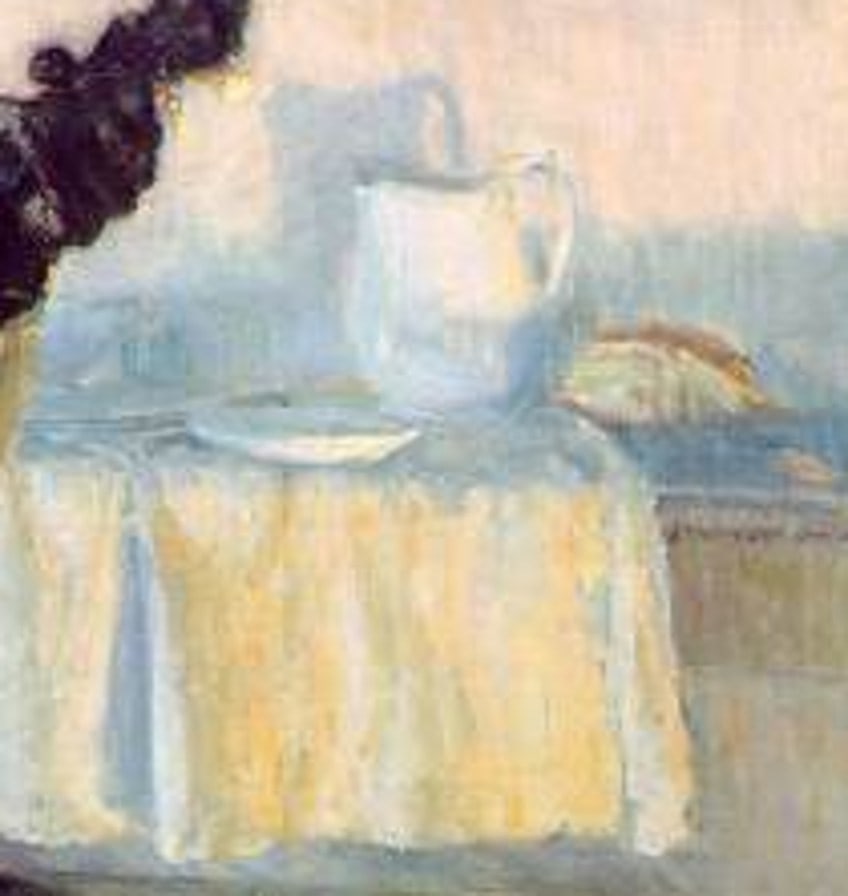 Colour and light in The Banjo Lesson (1893) by Henry Ossawa Tanner;Henry Ossawa Tanner, Public domain, via Wikimedia Commons
Tanner creates a delicate compositional carve up with his use of these lighter (fireplace) and darker (window) areas. Some sources propose the symbolism inherent in this play on "shadow and light", which places the older man more into the libation tones and the younger boy into the warmer tones.
This seemingly highlights the centrality of the young boy, who symbolizes the future, as the recipient of wisdom and noesis from his elderberry, who symbolizes the by.
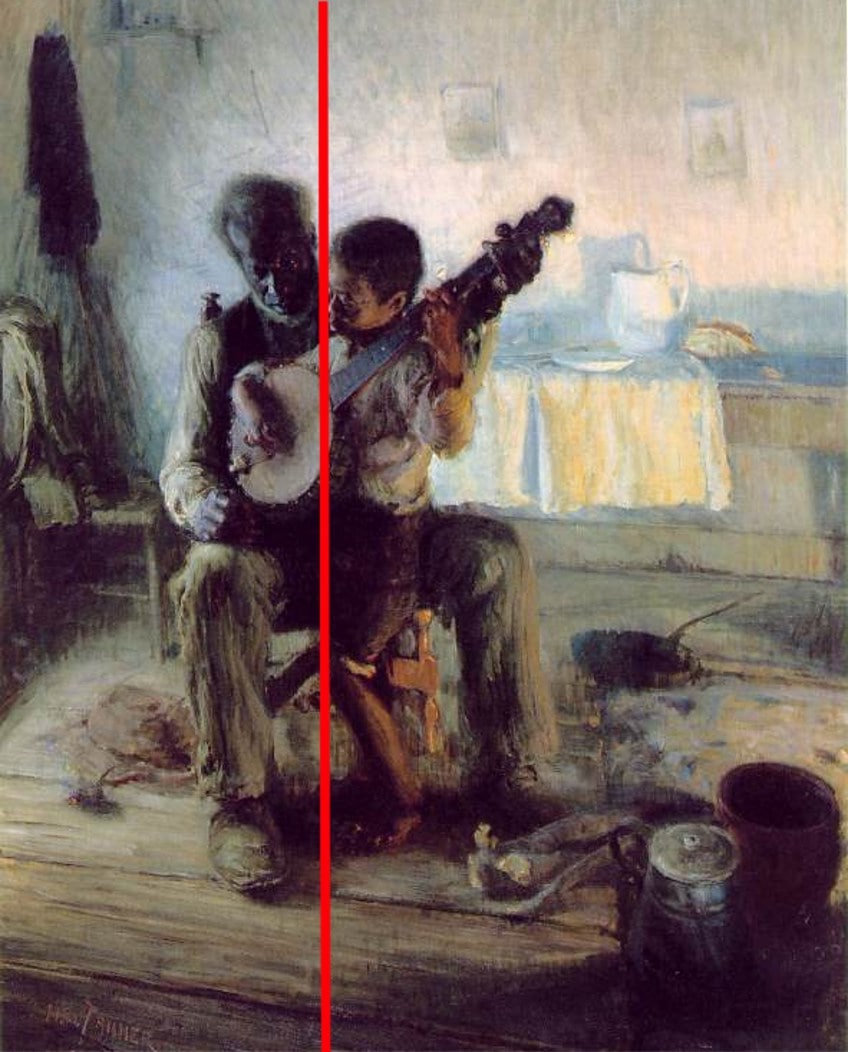 The separation between cool and warm colors in The Banjo Lesson (1893) by Henry Ossawa Tanner;Henry Ossawa Tanner, Public domain, via Wikimedia Commons
Furthermore, the colors that Tanner utilizes are neutral tones and like shooting fish in a barrel for us, the viewers, to gaze at. There are too areas of dark shading, specifically around the figures. These all create a sense of calmness roofing the limerick, emphasizing the scene's gentle nature; there are no harsh and vivid colors that would otherwise create a liveliness that might seem out of context to the scene and its message. Tanner utilizes expressive and loose brushstrokes, which may hint at his influence from the Impressionist fine art way of the time.
Nonetheless, we will find various stylistic influences evident in Tanner'south painting style that come up from the Genre-styled paintings of Thomas Eakins, including the Italian Renaissance Domenico Ghirlandaio.
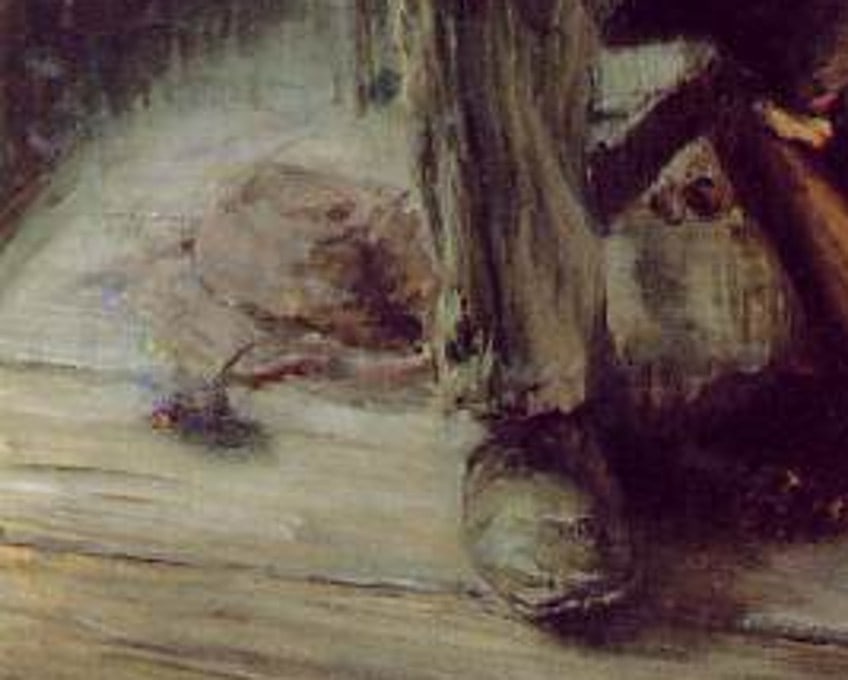 Brushwork in The Banjo Lesson (1893) by Henry Ossawa Tanner;Henry Ossawa Tanner, Public domain, via Wikimedia Commons
The Banjo Lesson has been compared to Ghirlandaio's painting An Former Man and His Grandson (c. 1490), additionally other Flemish painters similar Johannes Vermeer and his painting Woman with a Lute (c. 1662 – 1663). We will notice how Tanner's scene resembles the placidity attentiveness from these above-mentioned paintings. There are additional paintings that Tanner'due south The Banjo Lesson painting as well draws influence from, specifically The Angelus (1857 to 1859) by Jean-François Millet, who was a Realism painter.
We volition run into that Millet likewise portrayed repose, merely affecting scenes of peasants and their lives dedicated to farming.
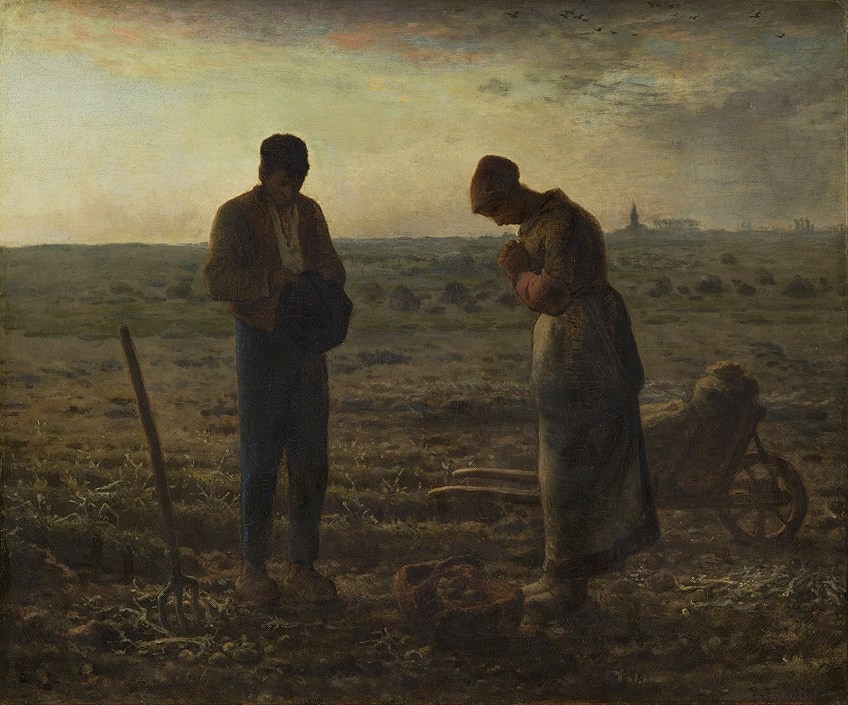 The Angelus (1857-1859) by Jean-François Millet ; Jean-François Millet, Public domain, via Wikimedia Commons
Some other notable artist was Gustave Courbet, also a French creative person from the Realism movement, who portrayed scenes of everyday people, especially peasants. Similarly, he gave a platform to those who take not been seen or heard in gild, and Tanner's paintings followed in similar footsteps.
Art was non simply art, it was a platform for those who were seemingly shoved aside past the rules and rigor that underlined traditional artworks, similar religious paintings, and how they should be.
"Monsieur Tanner, L'artiste Américaine"
The Banjo Thespian painting was exhibited at the distinguished Paris Salon in 1894. His other painting, The Thankful Poor (1894) was created in the same spirit of portraying African Americans with respect. Tanner's creative oeuvre has been described by various sources as moving in a different direction afterward he created the above-mentioned paintings, 1 in which he started painting religious scenes.
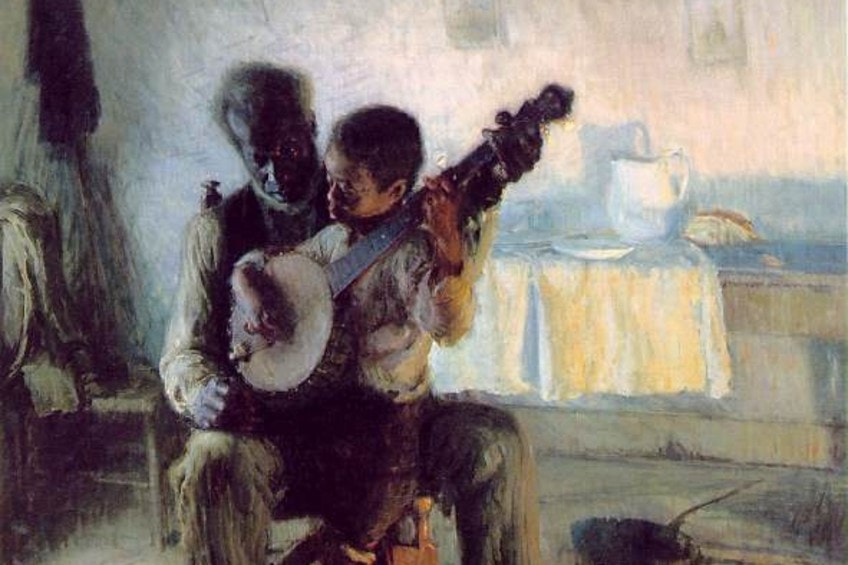 Close-up of The Banjo Lesson (1893) by Henry Ossawa Tanner;Henry Ossawa Tanner, Public domain, via Wikimedia Commons
In The Banjo Lesson painting, Henry Ossawa Tanner set up a scene with sensitivity to his field of study thing. Combined with his utilization of colour and the depiction of calorie-free, he redefined the identify and office of African Americans in American society, but besides his function within the world of fine art.
Tanner became a revered African American artist, 1 of the best in fact, and his piece of work showcased his creative abilities that went beyond racial divides. He lived in Paris merely understood and shared the roots that lay deep in the hearts and memories of those in the Usa, who ultimately fought a fight for freedom – a liberty we see in each stroke of Tanner's paintbrush.
Frequently Asked Questions
Who Painted The Banjo Lesson Painting?
The Banjo Lesson (1893) was painted by the African American artist Henry Ossawa Tanner.
Where Is The Banjo Lesson Painting Now?
The Banjo Lesson (1893) by Henry Ossawa Tanner is housed at the Hampton University Museum, which is in the land of Virginia in the United States. Robert Curtis Ogden donated the painting in 1894 to the Hampton Institute, otherwise known as Hampton University.
What Does The Banjo Lesson Painting Mean?
The Banjo Lesson (1893) painting by Henry Ossawa Tanner holds significant meaning regarding the way African Americans were portrayed during the xixth century. In this painting Tanner depicts the subject with more poignancy and respect compared to the more stereotypical depictions of African Americans as entertainers, generally playing the Banjo instrument, and ultimately in the position of slaves.
Source: https://artincontext.org/the-banjo-lesson-painting-henry-ossawa-tanner/
0 Response to "Images of Painting of African Americans in the Arts"
Post a Comment