If Christ Had Left Any Part of His Undertaking Unfinished He Had Been Sent Back Again
DR. GRESHAM MACHEN – UNRECONSTRUCTED CHRISTIAN:
A MEMOIR
past the Rev. H. McAllister Griffiths
Three passing years have bandage their shadows over "this little landscape of our life" since that New Year'south Twenty-four hours of 1937 when, having finished the work he had to exercise on earth, J. Gresham Machen was called into the presence of the Christ he loved.
Fourth dimension gives perspective, but as distance gives it. Information technology has its own manner of revealing persons and events in truer relative importance. The original facts remain unchanged. We simply encounter them ameliorate.
Neither the grapheme nor the fame of Doctor Machen stands in need of whatsoever embellishment. The very attempt would be an practise in futility. What he was, what he did, and the principles underlying his life in activity speak for themselves when rightly perceived and related. And it is my profound conviction, first formed more xv years ago but ever increasing in certainty, that when the long scroll of Christ's servants is called out in the great 24-hour interval, the name "Machen" volition vest in that select visitor of immortals that includes Athanasius, Augustine, Aquinas, Luther, Calvin, Xavier and John Wesley.
What was he, then?
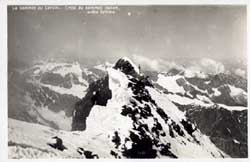
| In every cobweb of his existence, he was a redeemed sinner. He was very fearless earlier men but very humble before God. Everything else sprang from a primary and overwhelming sense of obligation to the grace of God in Christ. He was not his ain, never thought of himself every bit his own, never conserved strength or time or substance for his own indulgence. He spent himself for Christ. And even in those weeks when he could be persuaded to "rest" himself in his beloved Alpine mount climbing (at which he was far from a novice) he would see, in those stately distances, the majesty and holiness of the sovereign God. I do not mean that he viewed the world of beauty with a merely didactic or moralizing eye. But since his life was a Christ-centered life, since the globe of visible forms and events was to him permeated with an eternal purpose, everything beautiful and true and good alleged the presence and glory of the One who is ineffable. | |
 |
John Gresham Machen, born in Baltimore in 1881, learned to know and to dear the Lord Jesus Christ at his mother'due south knee. His father, too as his mother, was an exceptional Christian, just the communion between son and mother was especially intimate and sacred. Both parents were persons of civilization and refinement in the older, non-debased, meaning of the words. Doctor Machen's tender tribute to his mother in the short personal sketch given in "Contemporary American Theology" (1932) lifts but a small corner of the veil of his middle. If 1 is to find any real parallel one must go far back in Christian history, to read in the "Confessions" of Augustine the life and grapheme of Monica, and of the mystical moments shared by mother and son in Ostia, before her death.
What a generation of servants of God we would accept if the Christian mothers of petty children would but realize what they, and they alone, can do in the forming of faith and graphic symbol! What areas in developing minds and hearts can never be reached by schools or teachers, no matter how well trained or eager! Yet so many well-significant Christian mothers retrieve their duty done when they requite to their children a bare, smattering of "Bible instruction," while the deep harpstrings of Christian feel never vibrate, considering never touched. Mrs. Machen touched them in her son and their rich music of grace rang out to set the melody echoing in countless others. Behind this man, then, was his devoted female parent, from whom the Gospel was not simply "learned" but through whom information technology entered as an essential element of the fabric of his soul.
Socially, Md Machen was a child of the old South. I do not mean that he ever suggested a wish that the processes of history might somehow be reversed: he recognized their finality. Only there was bred in him a nostalgia, a heimwehr, for what Tennyson called "the tender grace of a day that is dead." Of his granddaddy's old home in Georgia he once wrote" "Its fragrance and its spaciousness and simplicity were typical of a by-gone historic period, with the passing of which I am convinced that something precious has departed from human life. In both my father and my mother, and their associates whom I saw from time to time, I caught a glimpse of a courtlier, richer life, and a broader culture than that which dominates the metallic age in which we are living now." This unconcealed stance led some persons of but rudimentary agreement to phone call him a "pessimist"; others attempted to explain away his love for the Gospel by declaring that it was simply one phase of his "congenital conservatism." How shallow such representations were! Then far as knowledge and understanding of things new are concerned, Md Machen was modernistic to his fingertips, and the listen that encompassed the earth in which he lived was well-nigh encyclopedic. So far from lagging behind modern life and thought, he really was far in advance of it. Looking upon the Gospel as eternally fresh and new, he saw Modernism and all the other ephemeral footling isms for exactly what they were, and envisaged the time when they would be bygone curiosities interesting only to an antiquarian. "There are things in sky and earth," he wrote, "never dreamed of in our mechanistic world. Some twenty-four hour period there may exist a truthful revival of learning, to have the identify of the narrowness of our historic period; and with that revival of learning there may come, as in the sixteenth century, a re-discovery of the gospel of Christ."
When you have a human of Physician Machen's native power, requite him the background he had, the tender teaching that was his, the exceptional formal instruction that followed and, above all, the rich Christian experience that came early on in life, you lot take the main outline of the man. Some people called him an "unreconstructed insubordinate"; to me the words that head this little memoir were far more plumbing fixtures: he was simply an unreconstructed Christian.
Dr. Machen never liked to be called a "Fundamentalist." He said to me once, "A new proper noun is ordinarily practical to something new. Simply what we stand for is not new. It is celebrated Christianity. When we let ourselves to be labelled with a new name it may pb people to retrieve that we are exponents of something different from the historic faith of the Church building." Yet he felt and then strongly that if anyone asked him, "Are you a modernist or a fundamentalist?" he should answer at once, "I am a fundamentalist." Non to do so, he held, might cause some to call up that he hesitated betwixt Christianity and its opposite modernism.
Along with an intensely burning love for Christ it was most natural that he should dearest the written Discussion. And then he became its diligent student. This is neither the time nor the place to set forth his equipment for the study and exposition of the Bible. But that it was second to that of no living man seems incontrovertible. One needs but read his published books to realize this. From the lucid, stringent "Christianity and Liberalism" (which he afterward wished he had called "Christianity and Modernism"); the stimulating, inexorable logic of "The Origin of Paul'due south Religion" in which he marches from objective to objective similar a mod mechanized ground forces; the glowing, centre-warming "What is Religion?" (his greatest book, I recall); the awe-inspiring wealth of learning revealed in "The Virgin Birth of Christ"--in every page of these shines out his knowledge of the Word. Merely in that location is something else there, too, even more noteworthy. That is, Doctor Machen's very real and sincerely apprehensive subjection to the Word. He did not read information technology or employ information technology to bolster upward the ideas of J. Gresham Machen. He read it to learn the truth and the volition of God. I never heard him quote any Scripture casually, in jest or, for quick advantage, out of context. He always approached the Word reverently, because information technology was the Word of God. And considering he loved God's Word he dedicated its truth and its slap-up arrangement of doctrine. Not that the Give-and-take needs any defending at all and then far every bit its truth is concerned, but that the minds of men need to be defended from misconceptions and from falsehoods about the Word.
One of the chief accusations hurled at Dr. Machen from time to time was that he was "gloomy." Now, while I think that anyone who is never gloomy in this world of sin probably needs a mental examination, the intimation that Md Machen was habitually gloomy was only modernist propaganda. I have never known anyone more really human, in the best sense of the word. When he was in Princeton he conducted what he chosen the "Checker Lodge." That is, he would agree open house in his rooms in old Alexander Hall. Students would flock in, coming and going at will. There was usually a crate of oranges, a box of apples, cookies, and staggering amounts of ginger ale (nothing stronger). "Das," as his intimates chosen him, would provide anywhere from a half-dozen to a dozen checkerboards, and would wander around watching the games, perhaps eating an apple, with a grin that stretched almost literally, from ear to ear. When he would see anyone temporarily out of refreshment he would bustle to his side. With an expression of mock-seriousness he would wail, "Don't be a tightwad, boys, don't exist a tightwad!" as he pressed them to take more than and more.
Every bit a raconteur and performer of "stunts" upon social occasions, Doctor Machen was not merely practiced. He was brilliant, and could be so in whatsoever company without always cheapening himself or lowering his standards of taste. The thought that he was a "Gloomy Gus" with a bitchy grudge against the world is the sheerest misrepresentation. For down at his existence'southward cadre he was happy considering Christ had redeemed him, because that redemption expressed itself in the fullest evolution of every potentiality and facet of homo personality.
Coupled with the charge of gloom there was often the more serious charge that he was "very bitter." That likewise, it needs to exist said obviously, was a fabrication. But since a g people heard well-nigh him to every one that could know him, the lie ran faster than the truth. Truthful, he was, as deeply human every bit every one of the rest of us, and he himself was the last one to claim that he was without mistake. He fabricated mistakes just every bit everybody else does. When he realized them he hastened to practise what he could to repair them. In that respect I never met a humbler man. Just to the repeated representation that he was bitter toward his opponents I echo that it was a pure fabrication. He oftentimes excused them and the things they said because, he would say, they were not themselves just and then.
Bitterness, as I sympathise it, is a vindictiveness of spirit that takes expression in mean words and acts. Merely there was nothing mean nigh Doctor Machen. Some, I fearfulness, mistook his zeal for the truth of God and the emotion stirred in him at the thought of Christ'south little ones being misled, together with its positiveness, for "bitterness." But many more called him bitter because he told the truth, and truth is always bitter to those whom it convicts. People who are really mean themselves sometimes try to pull a high-minded opponent down to their level by accusing him of "bitterness." What such people were really saying was, that from their point of view Doctor Machen was inexcusably tenacious. The one thing they could not endure about him was that he would hang on, then they said that he was "bitter."
So far as ecclesiastical action was concerned, Md Machen's standard was very unproblematic. Some acts are dictated by principle. They must be performed, no matter how "impolitic" they seem to exist, no matter how subject to misconstruction they are, no matter how hard. Other acts, not required past principle (i.e., a duty laid down in the Give-and-take), may be debated. Every bit to the first he was adamant. As to the second he was every bit reasonable a human being equally ever lived, and not at all dogmatic. Many of the decisions and courses for which he was blamed as not beingness "wise" belonged in the former category. But he had to practice them, no thing what the results, or whether they were the all-time "strategy." That is why he was ofttimes accused of being "stubborn." But that weep has been raised confronting every Christian from the fourth dimension of St. Peter on who has resolved to "obey God rather than men" and who has carried that resolution into practise. God ship us more such Christian men and women! Far better to be chosen bitter, to be dubbed stubborn, to become the barrel of little men'southward ridicule than to court the favor of men by sitting down to discuss with them whether to obey the command of God. To J. Gresham Machen the command of God meant, every bit it ought to mean to every Christian, great and humble, that there could be no fence. There might be debate and give-and-take every bit to how best to express obedience, but none at all as to the necessity for obedience.
Everyone observed--though his enemies could never quite grasp the reason--that Doctor Machen, well-nigh from the very beginning, attracted and held a devoted following of younger men. Not being able to understand the nature of this attraction, his traducers were wont to refer disparagingly to his "influence over unformed minds," sometimes even hinting--ever so delicately--that information technology was, in some way, sinister. All this, of course, was the merest eyewash, and just highlights the inability of those who were then bitter against him to proceeds whatsoever insight into the human being with whom they had to do.
The flower of real friendship and devotion does non sprout from the seed of mere intellectual admiration. No one ever fell in dearest with a parcel of qualities, whether mental or moral. Friendship can never exist coerced, only drawn, and the drawing must be mutual. Sources go deep into those subtle just powerful attractions which kindred spirits cruel for each other without always knowing why. In other words, friendship can submit simply betwixt persons, and the graphic symbol of the persons fixes the character of the human relationship. The common area on which the spirits come across may not be outwardly visible, may be felt rather than perceived, only it is always there.
Dr. Machen, while always the courteous gentleman, did not make use of artifice to gain friendship. He never flattered in lodge to attract. True, he was always generous when he idea praise was deserved, but the object was to bear witness how he felt, non to solicit a post-obit. Amongst his friends the kindness and the warmth which radiated from him was nothing calculated, only as natural and unaffected as breathing. He probably was not a human being to strike an attitude or assume a pose; nor did he ever attempt to requite younger men the impression that he honored them by admitting them into his circle. In a give-and-take, he was genuine. Mentally he was an accurate genius, with all the massiveness and differentiation distinguishing the mind of genius. Emotionally he was not complex at all. He loved goodness, beauty, and truth as he understood them and as wholeheartedly hated their opposites without soiling or demeaning himself into hating individuals. And that kind of simplicity is, I think, a rarer and greater possession that even mental genius.
No wonder we young men loved him! He was, in the exact sense of the word, a nobleman to the states precisely considering he never would have thought of himself in such terms at all. Self-best-selling "nobility" is without exception spurious. "Das" would have honestly regarded its imputation to himself every bit being funny. He was never happier than when among the boys--with himself every bit one of them. Youth is preternaturally keen in being able to sense the difference between the assumed "good-fellowship" of an older human being with an ax to grind, and, on the other hand, an older man who is genuinely interested in them, themselves, for their own sake, with no strings fastened. That was what we found in Das, and acquaintanceship issued into devotion as inevitably equally spring blends into full summer.
Yet, withal, the allure is but partially explained, the greater office of what has been written could be true of similar men, anywhere, any their organized religion and creed. But this went deeper, considering nosotros were Christians, and because we had been born into an era in which Christianity is a besieged fortress.
It is no mere theoretical aridity of doctrine that those who have received the Lord Jesus Christ have been born again, that in them courses anew, a supernatural life. The fact is the basis and the explanation of all truthful Christian experience. And since, equally has been noted, the grapheme of the persons determines the graphic symbol of their friendships, the communion of Christian with Christian tin realize potentialities of which the natural man can never know. Information technology possesses in Christ a greater, even so at once a more sectional, common ground upon which spirits may meet. Telephone call this mystical if you will: those who are Christ's, in whom He lives, may exist uniquely fused together in Him when they believe themselves called in His eternal purpose to proclaim His Gospel and are set for its defence against an encircling globe.
A cracking bargain of superficial drivel in ridicule of "self-appointed defenders of the organized religion" has gained wide currency in our day. The object, of course, is to make those who love the Gospel the butt of ridicule. But that is just the vox of raw, cocksure unbelief, speaking from the outside without even looking in. Many others in addition to the writer can rise to testify what the experience is similar from the inside. No fellowship can ever match for intensity or tenderness that which subsists betwixt those who, in obedience to a solemn dictate, try by God's grace to fight the good fight of organized religion. They won in defense of the I whose accolade is more precious than their own mere physical welfare or being. In that fight, from which each one of us naturally shrank, there were in the start many leaders. In the heat of battle some of them endured all until the end. Others fell by the wayside. A few galloped their white chargers to the rear, muttering that the fight should have been held some sunnier day. But one leader, more than the peer of them all, neither cruel nor ran. And to him, even long earlier the final denouement, the hearts of many immature men were drawn closely by mystical but powerful cords.
It is in the total bear upon of person upon person that that which binds them together may be viewed in its wholeness. Analysis risks distortion of the flick. Yet, still, certain attitudes and characteristics live vividly in retentiveness. They replenish their own illumination, nor does their oil need replenishing.
To hear his opponents talk about him, ane would get the impression that Dr. Machen was a modern Torquemada, a cold-blooded, soulless theological automobile who looked upon orthodoxy as a mathematical equation and upon the slightest divergence from information technology as mortal sin. How piffling, again, they understood the man! Truly, he held to the great system of doctrine of the Bible as unshakably eternal. Just to him it was no frigid exercise in mathematics, but a living trunk of truth springing from the heart and mind of God and centered in a glorious, redeeming Person.
Nor was he hard and full of censure against the immature men who had to fight disturbing battles in their own souls before full certainty could be found. No,--to them he was patience and assist and tenderness. He knew the long nighttime hours of inner disharmonize, when faith seems at its nadir and dubiousness a mocking jailer. He knew these things because he had experienced them, and because he besides had walked that road he could help others over its stony places. Many a man today can thank God for the human instrument who helped him to face every trouble squarely and fairly, non turning away from any difficulty, only finding the answer in the reasonableness and truth of the Word of God.
At that place were many who, while they lightly took ordination vows without really pregnant them, scoffed at Dr. Machen'south insistence that such vows should be taken sincerely or non at all and, once taken, kept with fidelity. Maybe they did not know that he had every moral right so to hold. He was graduated from Princeton Seminary in 1905. Only he was not ordained--mark the year well until--1914. During a portion of that period he did not know whether he ever could conscientiously employ for ordination. In later years he wrote, "It was not Germany, however, that commencement brought doubts into my soul; for I had been facing them for years before my German educatee days. Obviously it is incommunicable to hold on with the heart to something that one has rejected with the head, and all the usefulness of Christianity can never lead united states of america to be Christians unless the Christian religion is truthful. Simply is information technology truthful or is it not? That is a serious question indeed."
Then he mentioned some of the things that helped "as I passed through the long and bitter experience that the raising of this question brought into my life." Information technology was out of those "dark hours when the lamp burned dim" (as he himself described them) that the insight and strength came with which he helped others in the years that followed.
Thus was fused in him a deep humanity with a passionate insistence upon intellectual integrity. He never shrugged-off problems that were existent, as though they did not exist. He never advocated "short cuts" either in grooming for the service of Christ or in the testing of the claims which the Bible makes for itself. He realized that there is no conflict at all between reason and faith, that when rightly understood they coincide. So he did non enquire men to "have faith" in something that their minds could not believe. He took them, instead, to the Bible and helped them to see that information technology is credible, that its truth is demonstrable, that faith is neither a gamble nor a spring in the dark, but a resting upon the character of the self-revealing God. No wonder young men loved Dr. Machen, derived stimulation and force from him, learned to share his passionate dedication to truth, his aversion to annihilation intellectually shoddy. For by case and by axiom he appealed to all that was highest in them, mentally and spiritually.
Both space and personal inability forbid me from recounting the numerous other ways in which Dr. Machen was a friend, both to those of his ain generation and to those who were younger. He was never a human being to think them. But because his friendship in its various manifestations was so selfless, information technology evoked in others a devotion of a more indelible quality than if he had sought it.
I have mentioned Dr. Machen'due south passion for truth. He held that truth is ane and that, in a loftier and holy sense, it flows from the Person of God. Man may only partially and at times gradually, cover information technology. He may deny it. But truth itself is changeless because it is what it is. It does not belong to usa, nor is it malleable to the impact of our want. He held, too, that the Bible teaches a bully coordinated body of Truth. This fabric is more than a catalogue of carve up truths. It is a unity, and is and so revealed by God. Both the fact of its separate parts and the fact of their inter-relation are divinely revealed. When we analyze we encounter the separate parts, each in turn. When we view them all as a whole nosotros perceive their grand unity. In the first mode of looking, nosotros encounter many precious doctrines. In the second view, we see them as what, for want of a amend discussion, we call a "system" of doctrine. Now the word "system" is our human give-and-take, but the cloth of truth in the Bible to which we apply the give-and-take is not ours at all, but God'south, just as the separate doctrines are God's. Since He has revealed both, both are to be received, loved, and honored as from Him.
If we are to empathize, what God has thus revealed, Dr. Machen held, we must come across these two aspects of His truth in residue. Nosotros must non go so preoccupied with 1 doctrine, or one grouping of doctrines, that nosotros lose sight of their relationship to each other. The corrective for doctrinal baloney, in which we overemphasize one truth at the expense of others, is to perceive and glory in the divinely-revealed system. That keeps us in residue and restrains us from the excesses which almost invariably accompany doctrinal distortion.
But Dr. Machen likewise recognized that it is sometimes possible for men and so to overemphasize the fact that a system exists equally to forget, or seem to requite the impression of forgetting, the precious truths themselves of which the arrangement is composed. He was equally much opposed to that kind of doctrinal distortion as to the other. For him the "system" could never become a mere, mechanically conceived exercise in theology, in which living parts were combined to produce a sterile whole. It was all alive. It all combined together as a grand, heavenly symphony centered in ane theme: "The Son of God, who loved me and gave himself for me."
This system is sometimes chosen "The Reformed Religion." But the churches of the Reformation did not invent information technology. They found it in the Word. Information technology is sometimes called "Calvinism." But Calvin did not originate it. He, too, institute it in the Give-and-take. Others draw it as "Augustinianism." But the great Augustine, who had been for a millennium and a half with his Lord, did not conceive information technology. He, besides, institute it in the Word. For myself, I do non care what men call it, or whether they give it a proper name at all, so long equally they get a glimpse of its glorious mountain-tops, its fertile valleys, and its infinite distances. It is, I believe, as certainly the truth of our Lord, or His Deity, and that simply because information technology is revealed in the Discussion. That is where Dr. Machen plant information technology, and where he taught others to seek it.
Sometimes I experience that many who sincerely beloved the truth of God in all its wholeness do an unconscious and unintended disservice to it when they too-often telephone call it by the name of any of its man exponents. They practice not mean, nor do they suspect, that by the continual iteration and reiteration of the names "Reformed Religion" or "Calvinism" they create popularly the impression that they are advocating something simply human, something man-made. They requite the inadvertent impression of beingness sectarian, whereas this Divine Organisation is not sectarian at all. Certainly Dr. Machen never thought of it in any such terms. I do non think that many, if any, of those who were trained past him so conceive information technology. Merely that a large number of people have so understood them is both undeniable and unfortunate.
Dr. Machen taught us, and for this endless others (besides every bit I) are grateful, that in reality this Divine System, telephone call it what you lot will, is not only taught in the Bible, but has as well been the instinctive, underlying faith of the Church building universal. (For myself, I do not want to surrender to Rome the grand word, "Catholic," which means universal. The discussion belongs past historical warrant to those who hold the Faith in its thou simplicity. Protestantism is a return to the original Cosmic faith, not a difference from it. The word belongs to u.s.a., not to Rome the corrupter, and we ought to merits information technology.) But, of this, as Dr. Machen pointed out again and again, in spite of their creeds most men and women are Calvinists (I employ the discussion for convenience) when they pray. They ask God to take the initiative whenever they pray for the conversion of a lost sinner. Thus in their hearts they believe that the Holy Spirit is the exclusive amanuensis in salvation. They pray every bit if they believed in the Divine System men call "Calvinism" merely because in that location is no other way to pray for the salvation of the lost. Christian instinct here universally recognizes what imperfect understanding of the Bible may deny. Below the diversities and discordances of men is this response of the redeemed center to the unmerited grace of God in Christ. This is i of the lessons which I learned from Dr. Machen, and for its comforting breadth I shall be eternally grateful.
Dr. Machen is what men call "dead." But nosotros Christians employ the give-and-take only as a convenience to convey the fact that soul and body are separated until the resurrection of those who accept been made "just" past the blood of Christ. The soul, the seat and center of his personality, is with Christ, "which is far improve." If we really love our Christian "dead" we could never wish them back. But what of the work Dr. Machen left behind him on earth?
His work on world was done. In that location are no accidents in God's eternal purpose. Though his task looked unfinished to us, God knew that it was completed. And then He called His servant Habitation.
But what of the influences he left backside, in other men, in movements?
1 of the things which Dr. Machen used to echo over and over again in the winter of 1935-1936, when separation from the Presbyterian Church in the U.South.A. was impending, was: "We must not allow this movement to run out into the sands." He meant, of course, that information technology must not exist dissipated by losing its distinctive witness, which was the bang-up tradition for which the Presbyterian Church in the U.s.a.A. had once stood, but which was beingness abandoned. Outwardly at that place was every reason to tremble. The icy winds of sure "defeat" were blowing, and many who had vowed to endure and to "go out" if necessary were falling from us similar dead leaves from trees in a November gale.
I shall not attempt hither to deal with events from June, 1936, until the present, or to talk over the developments which led to the situation we have today. Such treatment does non properly belong in this memoir. But information technology is proper to inquire this question: In view of the beingness of two relatively small-scale churches and the fact that a large number of his former pupils are in the Presbyterian Church building in the U.S.A., and elsewhere, has the move of which Dr. Machen became the outstanding leader "run out into the sands"?
The answer is, emphatically not, with differing emphases the 2 churches organized following the disruption of 1936 stand firmly for the Bible, its Christ, the precious doctrines of the Word and its Divine System. Their separation, we must believe, is in God's eternal programme and hence serves both His purpose and His glory. If Christ tarries they volition grow and will replenish focal-points about which others may rally in years to come.
Nor is this all. There are many others who agree to the faith and who were securely influenced by Dr. Machen, who are yet in the Presbyterian Church in the UsA. I cannot meet how they can exist annihilation simply badly unhappy. They are, in our view, in an intolerable state of affairs. I firmly believe, and am willing to submit this belief to the arbitrament of time, that they will eventually come to the identify where they come across that their fellowship with Modernism is unholy. Then they, as well, volition come out. In other words, the exodus from the one-time body has as yet hardly actually begun. Merely it will come up, as surely equally daybreak, and the signs of it are non wanting.
Yet another consideration: many of those whom Dr. Machen influenced and taught are not in Presbyterian Churches at all. Now all readers of the Beacon know that I believe, every bit Dr. Machen believed, that Presbyterian government is founded upon and agreeable to the Discussion. Merely he did non believe, nor practise very many, that the grade of Church government is prescribed in Scripture. Historically Baptists, for instance, were what men call Calvinistic. The truth of God, be it said to His praise, is not confined to any 1 form of government. The everlasting Gospel is one, whether preached from an Episcopal, Presbyterian, Lutheran, or Independent pulpit (I include Baptists under Independents). Nor will the power of the Gospel exist stayed considering those who preach it may be mistaken every bit to the well-nigh Scriptural method of shepherding the flock of Christ.
One should never forget that Dr. Machen'southward books are still widely read and will exist read for a long time. The influence they are exerting and will exert is incalculable. Some of them are for the "patently man" of whom he used often to speak. Others are monumental works of learning and reasoning,--books which gained him world-wide respect even amongst radical modernist scholars. All his published volumes are in able elucidation or defence force of the Bible.
And final of all, the Gospel with all its fulness of truth, which Dr. Machen preached and defended, will become on because information technology is greater than whatever human. Dr. Machen himself would have been the start to affirm this. Truth makes its way because it is God'south. It may be obscured only men cannot permanently suppress it. The history of the Church Catholic is the history of the supremacy of truth and the inability of the world, either within or outside of the Church, to kill it. New Reformations will come, new revivals. The movement is God's, not Dr. Machen's. He was the retainer of God, and with that championship, and all the self-abnegation as well as the honor that it represents, he would exist well content.
He loved Christ and his fellow men greatly, because Christ kickoff loved him. And to that God--Father, Son and Holy Spirit--he would even equally we, give all the honour and the celebrity.
©PCA Historical Center, 12330 Conway Route, St. Louis, MO, 2018. All Rights Reserved.
Source: https://www.pcahistory.org/ms/machen/unreconstructed.html
0 Response to "If Christ Had Left Any Part of His Undertaking Unfinished He Had Been Sent Back Again"
Post a Comment